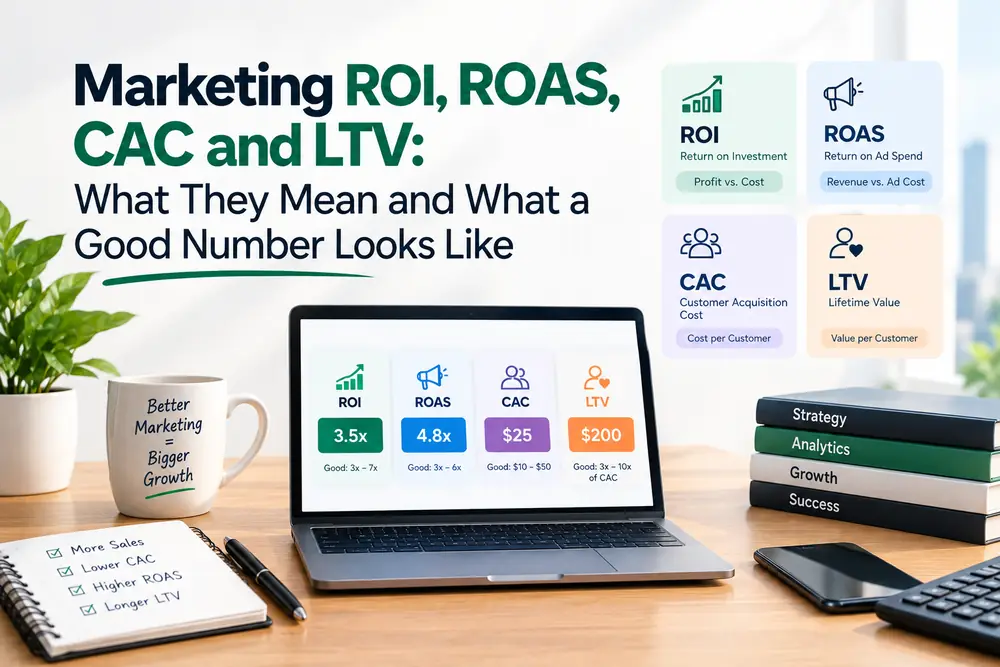
Business owners hear these terms constantly: ROI, ROAS, CAC, LTV. Agencies and ad platforms use them, but they're rarely explained simply. Here is what each one means, how to calculate it and how to decide what a good number is for your business.
The key metrics
- ROI (return on investment): (gain minus cost) divided by cost. If you spend $1,000 and earn $3,000 in profit from it, ROI is 200%.
- ROAS (return on ad spend): revenue from ads divided by ad spend. Spend $1,000, earn $4,000 in ad-attributed revenue, and ROAS is 4.
- CAC (customer acquisition cost): sales and marketing cost divided by new customers won.
- LTV (lifetime value): the profit an average customer brings over the whole relationship.
- MER (marketing efficiency ratio): total revenue divided by total marketing spend, which smooths over platform tracking differences.
- Payback period: how long it takes a customer's profit to repay their CAC.
Why ROAS alone can mislead
ROAS counts revenue, not profit. A ROAS of 4 sounds great, but if your margin is only 20%, you lose money. Always compare to margin.
Break-even ROAS equals 1 divided by your gross margin (before ad spend). With a 40% margin, break-even ROAS is 2.5. With a 25% margin it is 4.
Marketplaces use ACoS
On Amazon, advertising cost of sale (ACoS) is ad spend divided by ad sales, which is simply 1 divided by ROAS. A ROAS of 4 equals an ACoS of 25%. See our Amazon PPC basics.
An illustrative example
These numbers are made up to show the method. Suppose a store sells a product for $60 with a 50% gross margin, so $30 gross profit per order. It spends $1,500 on ads and gets 75 new customers from them. CAC is $20. If each customer buys once, profit per customer is $30 minus $20 CAC, or $10. If many also buy again, LTV rises and the same CAC becomes more attractive. If customers rarely return, the margin for error is thin.
What is a "good" number?
There is no universal good ROAS or CAC. It depends on:
- Gross margin
- Repeat purchase rate
- Cash flow and how soon you need payback
- Your goal: profit now or growth now
A common approach is to set a ceiling for CAC from your numbers, then aim for payback within a period you can afford.
Watch out for these traps
- Platform-reported results that don't match your real sales
- Attribution gaps, where one customer is claimed by several channels
- Ignoring returns, shipping and discounts when calculating margin
- Judging a channel after very few conversions
- Comparing branded and non-branded search as if they were the same
How to set targets
- Calculate gross margin per product or service
- Work out break-even ROAS or maximum CAC
- Decide your goal: profit, growth or a mix
- Set a target a little better than break-even
- Review monthly with real sales data
Attribution in plain terms
Attribution is how credit for a sale is given to marketing channels. A platform may count a sale that other channels also touched. Last-click gives all credit to the final click. Blended measures, like MER, divide total revenue by total spend and avoid arguing over credit. Use both: platform numbers for day-to-day decisions and blended numbers for the big picture.
A simple weekly dashboard
- Spend by channel
- Revenue and orders or leads by channel
- Cost per lead or order
- Gross margin and break-even ROAS
- Cash collected versus cash spent
Targets for different models (illustrative)
- One-time purchase: aim for first-order profit or a short payback window
- Repeat purchase or subscription: allow a longer payback window if repeat behavior is proven
- High-value services: judge by cost per qualified lead and close rate
Questions owners ask
What is a good ROAS?
It depends on your margin. A ROAS that is profitable for one business can lose money for another. Calculate your break-even first.
What is the difference between ROI and ROAS?
ROI looks at profit against total cost. ROAS looks at revenue against ad spend only. ROI includes more of the real picture.
What if I don't know my LTV yet?
Start with first-order profit and a conservative payback period. Update the number as you gather repeat-purchase data.
How we report it
We tie reports to profit and plain numbers, not vanity clicks. Our Google and Meta Ads work starts with a tracking audit so the numbers can be trusted. Want help setting your targets? Contact us. You may also like our marketing budget guide.